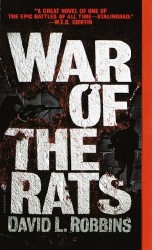
| War
of the Rats
by David L. Robbins Bantam Books, 1999, softcover 474 pages ISBN 0-553-58135-X |
 |
|
|
|
|
presents
Book Review,
November 2000:
| War
of the Rats
by David L. Robbins Bantam Books, 1999, softcover 474 pages ISBN 0-553-58135-X |
|
Although Stalingrad stopped the blitz, it perfected the Soviet sniper –and became the perfect terrain for a duel between the two most deadly snipers of the war, and, for that matter, between the Mauser and the Mosin-Nagant, one from Germany and one from the Soviet Union. The War of the Rats is an outstanding novel based on that duel.
Yes, you read that right—a novel! In a break from CRUFFLER.COM’s traditional book review genres, this month’s review is of a novel based closely on the historical accounts of the sniper duel during the siege of Stalingrad. Indeed, in his introduction, David Robbins states that three of the four main characters were actual combatants in Stalingrad, the fourth being a composite character created for the novel. The basis of the story is real, and although the thoughts and feelings of the people involved cannot be known and can only be imagined, The War of the Rats will bring you into the world of the sniper as few books, either fiction or non-fiction, can.
The Soviet “hero” of the novel, Chief Master Sergeant Vasily Zaitsev (n.b. – Zaitsev means “hare” in Russian.) was a hunter from Siberia prior to the war started. Enlisting in the Soviet Navy, Zaitsev spent the first part of the war awaiting a Japanese attack on Soviet far eastern territories that never came. As the Nazi invasion plunged deeper and deeper into the Soviet heartland, the Voina (Soviet High Command) became more and more frantic in the search for men and machines with which to stop it. Eventually, those formations which had been guarding the east were thrown into the fray. These units included naval organizations pressed into service as infantry. To distinguish themselves, and as a matter of pride, the naval infantry units wore their blue and white striped jerseys underneath their olive drab infantry uniforms. Interestingly enough, this tradition is continued in the Russian Army to this day with Spetsnaz, or special operations forces. Zaitsev’s skill with the rifle, and more importantly, his skill as a stalker and hunter soon aroused the interest of his superiors. He became part of a Soviet effort to turn Stalingrad’s hellish landscape of gutted factories and burnt out tanks into a purgatory for the Nazi invaders where death might lurk around every corner, behind every piece of rubble and around the clock. In defense of the motherland, Zaitsev turned the skills he had learned hunting wolves in the steppe to hunting Nazi officers and machine gunners in Stalingrad. So successful is Zaitsev that the Red Army instructs him to take his partner, Victor Medvedev (n.b. – Medvedev means “bear” in Russian.) and organize a school for snipers in the ruins of Stalingrad.
Zaitsev’s teachings bear fruit. Desperate for good news and for heroes, the Soviet press lauds Zaitsev’s accomplishments, and his name becomes known throughout the Soviet Union. Unfortunately for Zaitsev, his name becomes known in other circles as well. Specifically, the Nazi high command decides that the Soviet hero must be liquidated, not only to deal a sharp blow to Soviet morale, but to revive the flagging spirits of the German forces and their axis partners fighting in Stalingrad’s cauldron. Chosen for the task was the best sniper the Nazis had. SS Colonel Heinz Thorvald, chief instructor at the German sniper school in Berlin is dispatched to Stalingrad with an open ended mission: eliminate the annoying man from the steppe…
The book slows occasionally and propagandizes, descending into a sort of “Stalinist realism morality play,” where the stolid, faithful, and ever so proletarian Zaitsev is contrasted to the imperious and egoistic Thorvald. Robbins evidently doesn't want his readers to like the Nazi, and, in the final analysis, that's fine by us. After all, who ever likes the bad guy in a western, or the murderer in a crime drama? Robbins didn't set out to write one of the seminal works of literature for the 21st century. He set out to tell a story, one based on fact to be sure, but a story nonetheless that would constantly engage the reader and keep the pages a’turning. In this he succeeds admirably.
Robbins draws his readers in with breathless action and carefully chosen detail. His prose style is crisp, clean, and engaging. The reader in enveloped by the words. The main characters are real, well developed and compelling. However, minor character development leaves something to be desired, and is often stereotypical and kitschy. Robbins writes much about the tradecraft of being a sniper, and this is fascinating in its own right. It is not, however as factual or detail laden Melville’s explanations of 19th century whaling technique in Moby Dick. As a result, the die hard cruffler will undoubtedly find discrepancies in the description of the firearms used in the book. While historical firearms technology may not be Robbins’ strong point, gripping narrative is. The novel gives the reader an idea of the horror of being in a war where an unseen enemy can take your life if you're careless, even for a split second, while performing such a mundane and necessary task as getting a drink of water.
And then there's the love interest. Why Robbins chose to have an American woman show up in Stalingrad and find herself in the midst of a Soviet sniper school is beyond the ken of this reviewer. Love interest? Sure. Love interests, if handled well can always make a good novel better. And historically, there was no lack for protagonists - there were plenty of Russian women, in and out of uniform, in Stalingrad during the novels time frame. But why an American is a mystery. Fortunately, the inclusion of this quizzical portion of the novel takes nothing away from the book.
In sum, The War of the Rats is a deliciously engrossing read that makes for an ideal companion in waiting rooms, airports, airplanes, and cold rainy days. It is the kind of book to pick up on a cold November day, as the ice is beginning to form on the Volga, and you can scan that pile of leaves outside your window, that wasn't there yesterday, for any suspicious changes…
War of the
Rats
is available from Amazon.com.
Click on the image to order: