 |
Browning High Power .22 LR Conversion Unit from JLD Enterprises | |
|
|
|
|
CRUFFLER.COM
presents
ACCESSORY
REVIEW,
October
2001:
|
Browning High Power .22 LR Conversion Unit from JLD Enterprises | |
GETTING TO CARNEGIE HALL
|
There really
isn't much of a secret to pistol marksmanship. It boils down to a
combining the fundamentals, such as trigger squeeze, breath control, sight
alignment, and grip with copious amounts of practice. While most
crufflers don't have to be encouraged all that much to shoot more often
than they already do, several factors enter into the equation other than
desire. Not the least of these is cost. With prices ranging
from $9.00 to $17.00 per box of fifty cartridges, the fiscal factor alone
is more than enough to dampen the ardor of all but the most well heeled
shooters.
Cost cutting options include handloading, using reloaded ammunition, or simply shooting less often. Each of these courses of action has drawbacks, however. Handloading requires a significant initial investment, and carries with it the potential of a careless moment leading to |
One of the most cost effective compromises available is the .22 LR conversion kit. These kits have the advantage of firing inexpensive .22 ammunition (as little as two cents per round), requiring the shooter to pay attention to the shooting fundamentals, and using the original grip and fire controls. Consequently, the converted pistol duplicates the weight, trigger pull, safety and firing characteristics of the original configuration, but at a fraction of the cost per shot. For a self loading pistol, the .22 conversion kit usually consists of a replacement slide/barrel unit and a replacement magazine.
The conversions operate on the blowback principle. That is, there is no mechanical interlock between the slide and barrel, and the only forces keeping the breech closed during firing are the weight of the recoil spring and the mass of the slide. This system works very well for relatively low powered cartridges like the .22 LR, and has the benefit of simplicity. Additionally the relatively violent blowback action offers a good approximation of the firing sensation of the original cartridge.
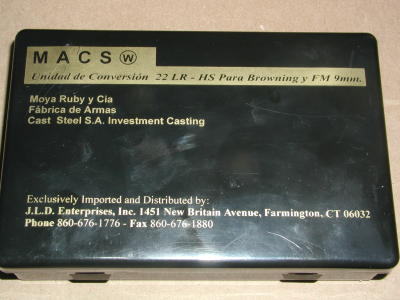
Conversion kits have been available for the Colt Government Model and its military analogs for quite some time, including kits offered by Colt and several aftermarket manufacturers like Jonathan Arthur Ciener, Inc. Interestingly, there have been few, if any, kits offered for what may be the world's most popular self loading pistol, the Browning High Power. That is until recently. JLD Enterprises of Farmington, Connecticut is now importing a .22 conversion kit for the High Power trade named the "MACS" and manufactured by Moya Ruby y Cia of Buenos Aires, Argentina. Moya Ruby is an arms manufacturing concern owned by Mr. Nestor Zungri that specializes in investment cast gun parts. Moya Ruby had been producing the MACS kit for several years for domestic consumption in Argentina when an enterprising mutual acquaintance of both Mr. Zungri and Jose Diaz of JLD Enterprises suggested that there might be an interested market in the United States for the MACS kit. The rest, as they say, is history.
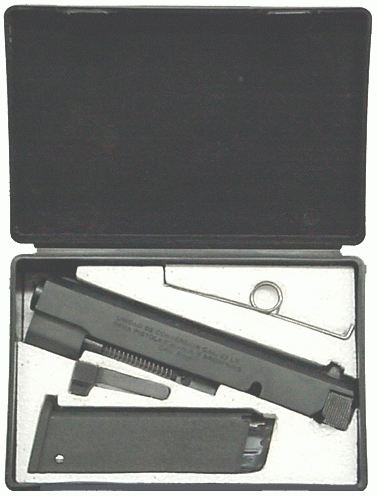
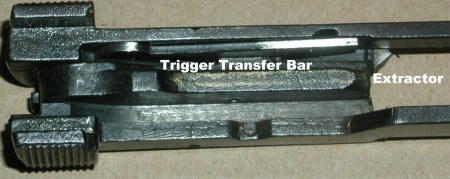
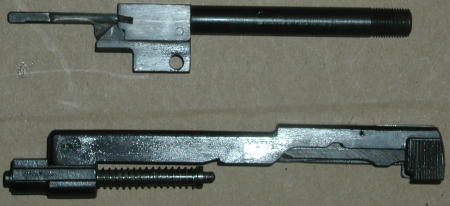
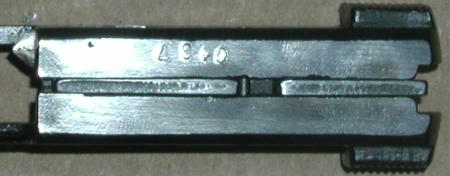
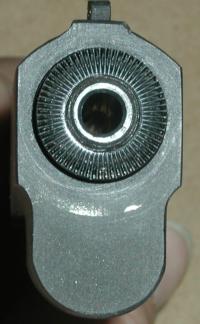
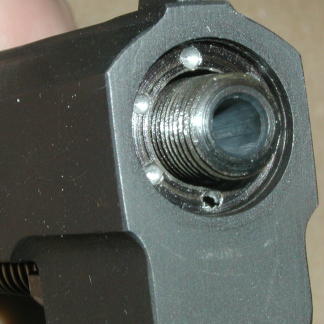
The kit itself comes in a fitted plastic box and consists of a replacement top end, a replacement slide stop, a replacement magazine and a disassembly tool. The top
|
|
|
|
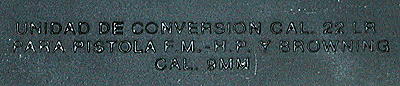
The left side of the slide is marked:
|
PARA PISTOLA F.M. - H.P. Y BROWNING CAL. 9MM |
|
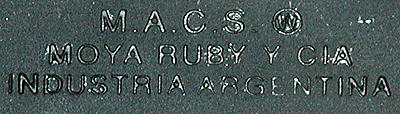
The right side of the slide is marked:
|
MOYA RUBY Y CIA INDUSTRIA ARGENTINA |
|
Installation is simplicity itself and takes less than thirty seconds. The original slide is retracted, and the safety pushed upward into the disassembly notch. The slide stop is pressed out to the left, the safety is lowered, and the slide eased forward off
|
the frame. The replacement top end is then slid on to the frame rails, and the replacement slide stop slide home to lock the assembly in place. The barrel bushing is then tightened or loosened to ensure the proper fit of the top end on the frame. This final step is the key to the MACS conversion unit's astonishing versatility. By allowing for relatively loose tolerances on the slide to frame and barrel to frame fit, and then taking up the slack with a mechanical adjustment, a |
|
|
|
|
|
|
|
|
|
|
|
|
|
|
|
|
|
|
|
|
|
SHOOTING
THE MACS CONVERSION
Preparation for shooting the conversion
kit starts with loading ten rounds of high velocity .22 LR ammunition (the
owner's manual is very specific about using high velocity loads) into the
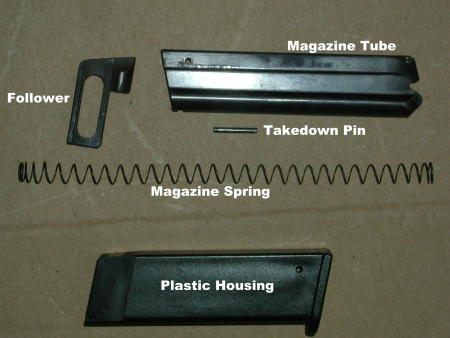
surrogate magazine. The magazine itself is an interesting assembly.
It consists of a stamped steel single column .22 magazine inserted into
a
| plastic housing that mimics the contours of the original 9mm magazine and held in place by a single transverse steel pin. While it was durable and reliable enough, it was also one of the most painful magazines we've ever loaded. The contours and edges on top of the feed lips are quite sharp, and none of the testing staff really wanted to load more than five iterations of ten rounds. From a purely ergonomic view, this magazine could benefit enormously from the inclusion of a thumb actuated follower depressor such as those found on Ruger |
|
Once the rounds are loaded, the magazine
is smartly inserted into the butt, and the hammer cocked. Next, the bolt
is grasped by the cocking serrations at the rear, pulled back to the furthest
extent of travel and released. A round is stripped from the magazine
into the chamber, and the pistol is ready to fire.
Firing the pistol is very interesting.
To begin with, it's not just a suggestion when the manual says to fire
only high velocity ammunition, and that a minimum of 200 rounds should
be fired in order to properly break in the conversion. Our test unit
would function with standard velocity ammunition, but only when the magazine
had six or fewer rounds loaded. Even with high velocity ammunition
there were numerous failures to feed or eject over the first two hundred
rounds. However, as we drew closer and closer to the magical 200
rounds, the number of rounds between failures began to increase, eventually
ceasing entirely. After the 200 round break in, the conversion was
entirely reliable.
Accuracy was very good with fifteen
yard groups of an inch or so being the norm rather than the exception.
The training value of the conversion is enhanced by the blowback "jump"
that induces a bit of muzzle flip and forces the shooter to concentrate.
We've no doubt that with a longer barrel and finer, adjustable sights,
accuracy would improve dramatically.
Conclusion
The MACS .22 conversion unit for
the Browning High Power is, at $195.00, priced competitively with other
conversion units. It's also the only game in town for the High Power
at the moment. It's also very well engineered, very well manufactured,
accurate, and after a break in period, reliable. Despite all these
positives, the kit is not perfect. We'd like to see the following
improvements (stress on the word "improvement" - these are most emphatically
NOT problem fixes):
These shortcomings are minor, however and do not detract from the kit's inherent utility, or for that matter, from the sheer fun it offers. While plinking with a MACS equipped High Power is great fun, and while we think that anyone who owns a High Power will thoroughly enjoy one of these kits, we offer this warning: The purchase of a MACS kit may very well cause the owner to engage in suspicious and compulsive behavior centered around the obsessive hoarding of empty twelve ounce beverage containers and the subsequent . But then, when you've got to plink, you've got to plink!
- Follower depressor for magazine
- Longer barrel and sight radius
- Adjustable sights
- Function with standard velocity ammunition
And now, our Buy-O-Meter rating for the MACS .22 Conversion Kit for the Browning High Power:
 |