| The
Boxer Rebellion
by Diana Preston Walker & Company, 2000, Hardcover, 436 pages ISBN 0-8027-1361-0 |
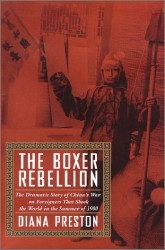 |
|
|
|
|
presents
Book Review,
August 2000:
| The
Boxer Rebellion
by Diana Preston Walker & Company, 2000, Hardcover, 436 pages ISBN 0-8027-1361-0 |
|
While the foreigners argued over how to slice up China, the remained oblivious to a popular movement that was sweeping across the Chinese peasantry. The movement was reactionary, mystical, and nationalistic. It was also virulently xenophobic and anti-Christian. The foreigners nicknamed the movement's adherents "Boxers" for the martial arts exercises they practiced publicly en masse. In 1900, the Boxer movement erupted into open violence against the foreign powers. Under the orders of the Empress Dowager Tzu Hsi, the Chinese Imperial Banner troops supported the attacks on foreigners, which escalated into a siege of the foreign legations in Peking. The conflict boasted an assortment of arms that would only be rivaled by the First World War. The imperial troops that confronted the foreign powers in China were armed with the latest Mauser rifles and Krupp and Creusot artillery. The foreigners defended themselves with the Krag, the Mauser, the Lee-Enfield, the Carcano, the Arisaka, the Mannlicher, and the Mosin-Nagant.
Diana Preston's The Boxer Rebellion is an account of the 55-day confrontation that alarmed the world. When Western and Japanese troops eventually routed the Boxers, soldiers and civilians looted the capital (to the benefit of Western museums) and extracted yet more concessions from China. The events of 1900 showed both sides at their colorful worst, and the author spares neither Chinese cruelty nor colonial pomposity and racism.
Events became surreal at times: champagne was more plentiful than water inside the embassies, and often the besieged diplomats smoked cigars to drown out the stench of dead bodies just beyond their walls. Still, the social graces were preserved, and the ladies of the embassy eagerly traded recipes for mule meat. The relief expedition was a rare example of cooperation among the Western powers, but rivalries remained fierce and often led to stupid command decisions (which, fortunately for the Europeans, the poorly organized Chinese forces were rarely able to exploit): after Peking fell, the occupying forces probably caused more death and damage than the Boxers themselves.
Preston's narrative is often told from a first person perspective which gives the reader a closeness to the chronicled events that is refreshing and engaging. Although the story is told entirely from the foreigners' viewpoint (of the 200 titles in the bibliography, not one is Chinese), the wealth of personal papers (diaries, letters, reports) from which Preston drew her story present an an interesting, if idiosyncratic, portrayal of the personalities and personages involved and a panoramic view of the the event as a whole.
The Boxer Rebellion is, without a doubt, a popular history. It is a little light on deep historical analysis but has all the pace and immediacy of a popular novel, Well written, The Boxer Rebellion makes for absorbing reading with plenty of fascinating information. This should not be read as a criticism, merely as an admonition that those who are expecting an immense, finely detailed tome will be somewhat disappointed. Popular history is an important if not critical genre for it makes the past engaging, fostering interest in eras and events that were formerly consigned the dust bin of time.
And the Boxer Rebellion is certainly
an even worthy of such interest. It left tens of thousands of Chinese
dead, precipitated the fall of the last Chinese imperial dynasty, and confirmed
Chinese xenophobia. Popular memory dies hard in China, and the aftermath
of the Boxer Rebellion left deep scars on the Chinese psyche that persist
to this day. The actions of modern China cannot be understood or
reckoned with in the absence of an understanding of her past. Diana
Preston's The Boxer Rebellion provides readers with an insight into
the shaping of modern Chinese policy that is all the more clear for being
removed from the sometimes distorting lens of Communism.
The Boxer
Rebellion
is available from Amazon.com.
Click on the image to order: