| Inglis
Diamond: The Canadian High Power Pistol
by Clive M. Law Collector Grade Publications, 2001, hardcover 312 pages ISBN 0-88935-265-8 $49.95 |
|
|
|
|
|
presents
Book Review,
June 2001:
| Inglis
Diamond: The Canadian High Power Pistol
by Clive M. Law Collector Grade Publications, 2001, hardcover 312 pages ISBN 0-88935-265-8 $49.95 |
|
Collectors and historians have never been more fortunate, having access to a huge number of well researched, written, illustrated and presented books whose focus parallels the range of collector interests. They range from broad surveys of the world's firearms such as Edward C. Ezell's Small Arms of the World, to those that concentrate on a particular type of firearm such as Handguns of the World (also by Dr. Ezell), to books that concentrate on firearms unique to a particular era or country, such as Jan Still's Axis Pistols. There are books that concentrate on a particular pattern or manufacturer such as Ludwig Olson's Mauser Bolt Rifles and George Madis' The Winchester Book. There are also highly specialized books that cover one particular firearm. An excellent example is Blake Stevens' work on the Browning High Power pistol, The Browning High Power Automatic Pistol. This book, reviewed in the September, 1999 issue of CRUFFLER.COM exhaustively explores the High Power, covering the pistol's historical and technical development, use by various governmental organizations, and variants to a level of detail sure to satisfy even the most demanding "Browning-phile." The degree of specialization doesn't stop here though; there are books dedicated to one specific variant of a given firearm. Such books are of particular value to the firearm historian and the advanced collector as their detailed and esoteric information is unavailable anywhere else. One of the best of the breed is Collector Grade Publications' latest offering, Inglis Diamond: The Canadian High Power Pistol.
By way of background, the Inglis High Power was a variant of the basic High Power pistol designed by John Browning and Dieudonne Saive, and produced by Fabrique Nationale (FN). Wholly a wartime phenomenon, the Inglis High Power was produced by the John Inglis Company of Toronto, a former boiler manufacturer. Despite what may be seen as a humble beginning, the Inglis pistols have had a remarkable history and longevity. Indeed, the Inglis, out of production for more than half a century, remains the standard sidearm of the Canadian armed forces. It is rugged, reliable, well made, and accurate. And it is also fertile ground for the firearms collector.
The Inglis is an excellent field of study: Though it was produced for a very short time and in limited numbers, there are four distinct models of the pistol, with a bewildering variety of markings and sub variants. Initially made for Nationalist Chinese forces as part of the Canadian contribution to the Allied Mutual Aid Package (Sent to the Chinese to aid in their fight against the invading Japanese Army), the Inglis pistols soon found themselves issued to the British Special Operations Executive (SOE), and later as the standard sidearm of the Canadian Army Overseas. After the war, the pistols were adopted by the armies of a number of nations, including the United Kingdom, Australia, Belgium and Peru. Inglis accessories are a fascinating field for collector activity in their own right.
Clive Law, Inglis Diamond's
author, is well qualified to tell the pistol's story. Born in London,
Mr. Law's family emigrated to Canada when he was four years old.
British and Canadian firearms and military history were strong influences;
Mr. Law's ancestors spent many years fighting for the British (on his father's
side) or against them (on his mother's side). His interest in firearms
started at age thirteen when a neighbor offered a box of gun parts.
Three days later the parts were assembled into a working gun, and two days
after that Mr. Law discovered what he'd built: an MG34 modified for
use on armored vehicles. Mr. Law's knowledge of the Canadian military
is thorough and intimate. He has served as an Infantry officer
with the Governor General's Foot Guards, and also commanded a platoon doing
the famous "Changing of the Guard" on
Parliament Hill in both 1974 and
1975. Mr. Law has worked for the Royal Canadian Mounted Police as
a "Firearms Identification Specialist," and is currently employed by the
Canadian Department of Foreign Affairs overseeing the import and export
of arms from Canada.
An accomplished and noted collector, Mr. Law is a long time member of the National Automatic Pistol Collectors Association (NAPCA), and the Lower Canada Arms Collectors Association. He has written several articles for the NAPCA journal "AutoMag". He was the founder and first editor of the National Firearms Association (NFA) magazine "NFA Journal." Currently, Mr. Law is the director of the Swords & Ploughshares Museum, a Member of the Organization of Military Museums of Canada, and was recently elected a Governor of the Company of Military Historians.
Mr. Law is president of Service Publications, a small publishing house specializing in books on Canadian materiel culture, and has written prolifically on the topic. His first published book, Canadian Military Handguns, 1855-1985 (Museum Restoration Services, Bloomfield, ON, 1995), addressed the procurement, use and disposal of all firearms in the Canadian military starting with the 1851 Colt Navy. Subsequent titles include Distinguishing Patches - Formation Patches of the Canadian Army, Khaki - Uniforms of the Canadian Expeditionary Force, and Small Arms Unit Marks.
Inglis Diamond, is the first full length study of the Inglis High Power. For collectors and historians alike, the book is a boon as it contains a large amount of information not previously available. Inglis Diamond is intended as a companion volume to The Browning High Power Automatic Pistol, picking up where the earlier volume leaves off. The book is divided into four parts: The first covers the developmental history of the Inglis High Power, the second deals with markings, accessories, and postwar variants, the third, the Inglis in foreign service, and the fourth is a production data summary. Each part is well crafted, displaying an intense synergy between Mr. Law's thorough research and his crisp and precise use of language. As with all Collector Grade titles, Inglis Diamond benefits greatly from Mr. Stevens' excellent editing and organizational skills.
Following the proven Collector Grade paradigm, the book is organized into several parts, each of which contains several chapters. The chapters are presented as a series of ordered vignettes, each of which highlights a particular facet of the pistol's history and use. This technique is extremely effective at conveying a large amount of information, much of which is technical and weighty with minutiae, in a manner that is easy to comprehend, easy to assimilate, and easy to retain. The reader is never overwhelmed with information, and as a result, Inglis Diamond reads as well for the novice collector as to the veteran historian.
Like its sister volume, Inglis Diamond is copiously illustrated with both photographs and engineering diagrams. Unlike many firearm books where illustrations are an end unto themselves, Inglis Diamond's illustrations merge nicely with the text to form a logical, intuitive unit, where each amplifies the other. Additionally, the book makes liberal use of lengthy captions to further amplify the imagery. With respect to presentation and tradecraft, Inglis Diamond excels.
The book's content is equally well done. Part one transports the reader to Second World War Canada and the byzantine machinations of Canadian ordnance development and procurement. The sheer number of agencies, organizations, and governments involved makes for a fascinating history. Add into the mix the various contract issues played out between parties including the Chinese government, the British, FN, the Canadians, and the Inglis Company, as well as the extensive trials carried out by various branches of the Canadian and British forces (with often contradictory results!), and the story takes on elements of the dramatic. Mr. Law organizes this complex historical drama and recounts it in an intuitive, logical manner that is clear and easy to follow. This is done without sacrificing either historical or technical detail. An example can be seen in this excerpt, discussing FN's retention of proprietary rights over the High Power design:
On November 23, 1943, a contract was drawn up between the Crown and FN for the manufacture in Canada of not more than 250,000 pistols. Part of the contract called for FN to supply three pistols as samples, and this had already been accomplished; one of these three pistols coming from Val Browning himself.Part two of the book, "The Collectible Legacy," details the Inglis' markings, accessories and postwar variants. Collectors will find this section of particular interest. Primary source materials, including factory records, official correspondence, and government documentation are used wherever possible to great effect. These are well supported with relevant illustrations. Mr. Law's research has yielded impressive results. For example, the story of the Mutual Aid Board insignia (the decal placed on the front gripstrap of Inglis pistols prior to shipment) is supported not only by photographs of the pattern actually used, but also with the artwork for five other competing designs. Covered in similar detail are accesories, holsters, shoulder stocks, a subcaliber device, magazines, and training aids. Part two also contains a fascinating series of stop action photographs showing an Inglis No.2 Mk. I* pistol in all firing stages between ignition and extraction during an experiment conducted on April 30, 1945. The part concludes with a survey of the postwar Inglis projects, including the refurbishment efforts to bring surviving guns up to No. 2 Mk.I* standards, postwar production plans, experimental lightweight pistols, double action conversion requirements, the Diemaco product improvement program, and the current work on a retrofittable firing pin safety.Once the agreement was in place, the Canadian Government made arrangements to transfer funds to Inglis to help that company set up its pistol production facility. According to a report to the Privy Council, in November, 1943, a total of $66,956 was granted as capital assistance. This grant was used to buy and install machine tools. Under the terms of the grant these tools were to remain the property of the Canadian Government, and in fact they were transferred from the John Inglis plant to Canadian Arsenals Ltd, a government-owned Crown corporation, after the war.
International usage of the Inglis pistols is covered in part three. Inglis usage was not confined to the Canadian, British and Chinese forces. After the Second World War the Inglis saw service with more than ten nations, including Australia, Belgium, the Netherlands, New Zealand, Brazil, Denmark, Greece, India, Malaysia, Mexico, and Peru. Inglis Diamond examines each of these "overseas postings," in detail. Typical of this section is this excerpt from Chapter 16, "The Dutch Inglis:"
Ultimately, Canada supplied approximately 10,000 Inglis High Power pistols to the Dutch through legislation passed in Canada in 1946, which allowed for the sale of military goods to the Netherlands. The Dutch originally called these Canadian High Powers the Pistool 46.Part three also includes information about the holsters and accessories unique to the foreign users. Part four is a useful data summary, including production data figures, serial number information and a brief section on commemorative Inglis' offered by the American Historical Foundation.These initial 10,000 pistols were shipped prior to the issuance in Canada of the 1947 Armourers' instructions for marking pistols, and consequently did not have the "No2" designation stamp added to the slide.
As noted above Inglis Diamond is one of the best books of its type that we've had the pleasure to read. It is a well presented piece of research that no one with an interest in these guns should overlook. This characterization however, fails to to the book justice. Inglis Diamond is uncommonly good reading; a scholarly work of history that sheds light on both the titular subject matter and the broader historical context of the Allied military-industrial complex during the Second World War. It is also an exhaustive collector's reference, covering markings, variants, details, and accessories. It also contains an astounding amount of technical information and illustration. More than a mere companion volume, Inglis Diamond stands on its own. Shooters, collectors, and historians, both novice and veteran, will find it a fascinating read. Our advice? Don't miss this one. (Editor's Note: Sounds like a perfect Father's Day gift to us!)
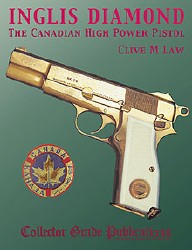
Inglis Diamond: The Canadian High Power Pistol is available from Collector Grade . Click on the image to order:
 |
 |